
Best Hockey Sticks Under $100 - Budget Performance Guide for Beginners
July 20, 2026
Here's a truth nobody selling $300 sticks wants you to hear: as a beginner, your stick is not what's holding you back. I've watched guys with top-of-the-line twigs whiff on wide-open nets, and I've scored with a $60 stick I bought on clearance. Sticks are also the thing you're most likely to break — a bad slash, a blocked shot, a slap on the crossbar — so paying premium prices while you're still learning is a fast way to light money on fire. Here are the best sticks under $100 for 2026 and exactly where it's smart to save.
The Quick Answer
Buy a one-piece composite from a real brand, and spend right up to the $100 line — that's where the entry models from CCM's actual lineups live. The CCM Ribcor 94K ($99.99) is the one I'd hand a beginner: it's a genuine low-kick stick from a flagship family, not a house-brand stick with a logo on it.
Under that, the drop-off is real. Between $60 and $90 you're mostly buying off-brand composites, which are fine and will not hold you back — they're just not the same stick. Skip wood unless cheapest-possible is the whole point.
Here's the short list, all senior sticks:
| Stick | Price | Why it's here | Best for | Buy |
|---|---|---|---|---|
| CCM Ribcor 94K | $99.99 | Real low-kick stick from a flagship line | Quick release, shooting in tight | Check Price → |
| CCM Jetspeed FT860 | $99.99 | The all-around pick at the same price | Beginners who aren't sure yet | Check Price → |
| Alkali Cele II | $89.99 | Cheaper composite, honest performer | Saving $10 and not caring about the logo | Check Price → |
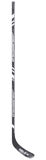
| Alkali Cele III | $69.99 | The floor for a composite I'd actually use | Tight budget, still want composite | Check Price → |
| CCM Ultimate Wood ABS | $33.99 | Wood. Heavy, cheap, unkillable | Stick-and-puck, "will I stick with it?" | Check Price → |
Those are Ice Warehouse prices from when I last looked, and they move with sales. One caveat worth saying out loud: make sure you're buying a senior stick. Youth versions of these same models show up cheaper in search results under nearly identical names, and a youth stick is short, whippy, and useless to an adult.
Why Budget Makes Sense for Beginners
Three reasons I always tell new players to keep it cheap at the start:
You will break sticks. It's not if, it's when. Blocked shots, edges of the boards, a teammate's skate, a hard one-timer into the crossbar. A snapped $80 stick stings for a minute. A snapped $300 stick ruins your week.
Your skills outrun your stick, not the other way around. The difference between a $70 and a $280 stick is weight, balance, and how "crisp" the kick feels on a hard shot. None of that matters until your mechanics are dialed in. Right now, ice time and reps make you better — not carbon layup.
Cheap sticks today are genuinely good. Composite technology that was flagship-only a few years ago is now standard on entry models. A modern $80 stick outperforms a premium stick from a decade ago.
Put the money you save toward more ice time or a learn-to-play program. That'll improve your game faster than any stick on the wall.
What You Actually Give Up
I won't pretend budget sticks are identical to premium ones. Here's the honest trade-off:
- Weight. Premium sticks are noticeably lighter. Over a full game, a heavier stick is a touch more tiring — but we're talking grams, and you won't notice while you're learning.
- Balance. Expensive sticks feel more "alive" in your hands. Nice to have, not need to have.
- Consistency of the kick point. Higher-end sticks load and release more predictably on hard shots. For beginners still building shot mechanics, this is basically invisible.
- Durability of the finish. Cheaper sticks can chip and wear a little faster cosmetically, though structural life is comparable.
None of these change whether the puck goes in the net for a new player. They're refinements you'll appreciate after you've got a season or two under your belt.
Best Sticks Under $100
Budget Tier ($30–70): Just Get on the Ice
If you're genuinely unsure you'll stick with hockey, or you just need something to hold while you learn to skate, this tier does the job.
- CCM Ultimate Wood ABS ($33.99): Wood, with an ABS blade that shrugs off abuse. Heavy and dead-feeling next to composite, and you'll want to replace it — but it's $34 and it will not break on you. A fine stick-and-puck beater.
- Alkali Cele III ($69.99): The cheapest composite I'd genuinely tell you to buy. Alkali isn't a name anyone will recognize at the rink, and that's precisely why it's $70.
My take: buy here only if budget is the deciding factor. Otherwise the $100 tier below is worth the extra thirty bucks.
The $100 Tier: Where I'd Actually Shop
This is the range I recommend to almost every beginner, and at Ice Warehouse it's a genuine cliff — the entry models from CCM's real lineups land right at $99.99.
- CCM Ribcor 94K ($99.99): My pick. Ribcor is CCM's low-kick family, so it loads and releases fast near your bottom hand — exactly what you want when you're learning to get a shot off before someone closes on you. The 94K is the bottom rung of that ladder, but it's the same idea as the sticks the pros use.
- CCM Jetspeed FT860 ($99.99): Same price, more of an all-rounder. If you don't yet know whether you're a quick-release player or a wind-up-and-blast player — and as a beginner, you don't — this is the safer of the two.
- Alkali Cele II ($89.99): Saves you $10 on the CCMs. I'd rather spend the ten and get a stick from a lineup I can reason about, but this is not a bad stick and nobody's judging you.
The Smartest Buy: Last Year's Model
The single best value in hockey is a previous-year mid-tier or high-tier stick on clearance. When new lineups drop, retailers slash last season's stock. You can land a stick that retailed at $180 for under $100. Same tech, older paint job. Nobody on the ice knows or cares.
Watch the clearance racks and end-of-model-year sales, and you'll routinely beat this whole list on value. That's not me being cute — it's genuinely better than anything above.
Getting Flex, Curve, and Length Right
A cheap stick that fits you beats an expensive one that doesn't. Quick rules of thumb:
- Flex: Start around half your body weight in pounds (a 180 lb player ≈ 85–90 flex), then go softer if you're a beginner or lighter shooter. Too stiff is the most common beginner mistake.
- Length: Standing in shoes, the stick should come up to somewhere between your chin and nose. Cutting a stick down raises its effective flex (makes it stiffer), so factor that in.
- Curve: A mid-curve, mid-toe pattern is the most forgiving all-around choice. Don't chase an extreme curve you saw a pro use.
I go deeper on all of this in Choosing Your First Hockey Stick — worth a read before you buy.
How to Save Even More
- Buy previous-year models. Said it above, saying it again — it's the biggest lever.
- Shop end-of-season sales. Spring is prime clearance season for last year's sticks.
- Consider a used stick — carefully. A gently used composite can be a steal, but inspect it hard: look for cracks, listen for a rattle (a dead giveaway of internal damage), and press on the shaft for soft spots. See Best Places to Buy Used Hockey Equipment.
- Don't buy two of the same until you know your curve. Dial in what fits first, then stock up on backups when it goes on sale.
Common Mistakes
Buying too much stick. Spending $250 on your first stick is the classic rookie move. Save it.
Flex too stiff. New players constantly buy sticks that are too stiff because "pros use stiff sticks." A softer flex loads more easily and helps you actually get shots off the ice.
Chasing a pro's curve. Aggressive curves are hard to control and punish beginners on backhands and passes. Stay moderate.
Ignoring length. A stick that's too long wrecks your stickhandling; too short wrecks your posture. Get it in the right zone before worrying about anything else.
Bottom Line
For most adult beginners: spend the full $100 and get the CCM Ribcor 94K, or the Jetspeed FT860 if you'd rather not commit to a shooting style yet. Tighter budget? The Alkali Cele III at $70 is a real composite and won't embarrass you. Better still: hunt down last year's mid-tier model on clearance for the same money.
Get the flex and curve right, expect to break a couple, and put the savings toward ice time. Your stick isn't the thing standing between you and better hockey. Reps are. Buy smart, then go get them.
See you on the ice.
| Photo | Product | Price | Buy |
|---|---|---|---|
 |
CCM Ribcor 94K CCM · Sticks |
$99.99 | Check Price → |
 |
CCM Jetspeed FT860 CCM · Sticks |
$99.99 | Check Price → |
 |
Alkali Cele II Alkali · Sticks |
$89.99 | Check Price → |
 |
Alkali Cele III Alkali · Sticks |
$69.99 | Check Price → |