Understanding Hockey Positions - Which One Is Right for You?
February 19, 2026
Not sure which position to play? I've been there. This guide breaks down center, wing, and defense — what each position actually does, the skills you'll need, and how to figure out which one fits your game.
Hockey Positions Overview
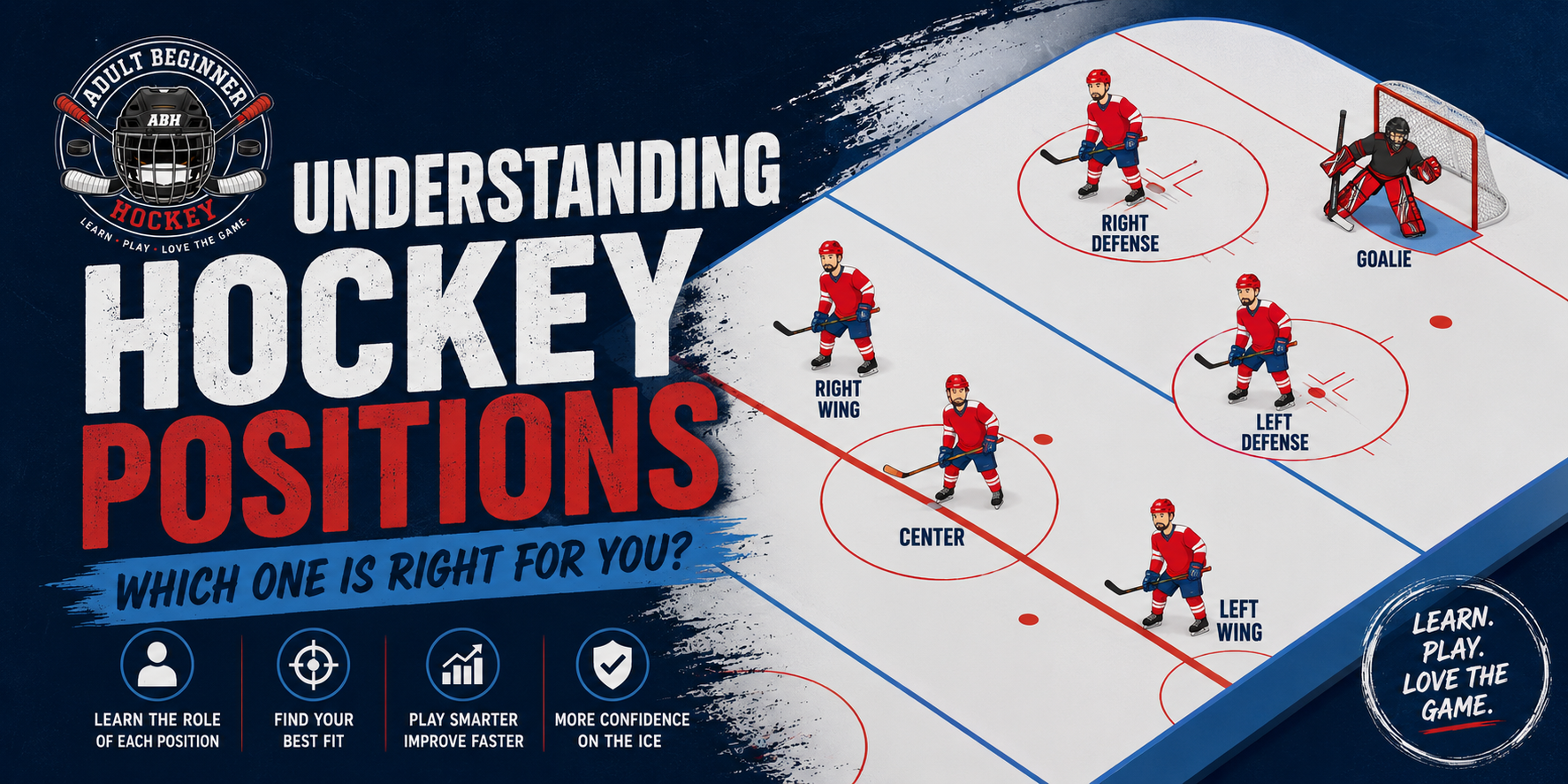
Hockey has five skater positions plus a goaltender. As a beginner, you'll choose between forward (center or wing) or defense.
The Positions at a Glance
Forwards (3 per line): 1 center and 2 wings (left wing, right wing).
Defense (2 per pairing): Left defense and right defense.
Goaltender: 1 goalie — but we won't cover that here. That's a whole different animal.
What Makes Each Position Different
Each position covers different ice, carries different responsibilities, and leans on different skills. Here's the whole thing side by side:
| Position | Ice you cover | Responsibilities | Skills emphasized |
|---|---|---|---|
| Center | The middle — you go everywhere | Faceoffs, two-way play, playmaking | Skating, vision, faceoffs, versatility |
| Wing | Along the boards on your side | Scoring, forechecking, support | Speed, shooting, forechecking ability |
| Defense | Back in the defensive zone, the point in the offensive zone | Defending, transition, point shots | Backward skating, positioning, passing |
The Reality: You'll Probably Play All of Them
Before you agonize over this, know that the chart above is tidier than any beer league actually is. Most nights you'll show up and there are nine skaters instead of twelve, or a defenseman is on vacation, or two guys are late. The lines get shuffled at the bench and someone ends up playing D who has never played D. That someone is often you.
So treat your position as a starting preference, not an identity. Tell whoever's running the bench what you'd rather play, then be willing to take a shift on the wing or drop back when the team is short. Being the person who shrugs and says "sure, I'll play D tonight" is genuinely one of the faster ways to get asked back.
The upside is that it makes you a better player anyway. A few shifts on defense teach you what your D actually need from you as a forward — and vice versa — faster than any amount of reading about it. Nobody in a beer league is locked in.
Center Position
The center is often called the quarterback of hockey. They're involved in every play and carry the most responsibilities on the ice.
What Centers Do
In the offensive zone, you're taking faceoffs, creating plays through the middle, cycling the puck down low, screening the goalie, supporting your wings, and being the first option on breakouts.
In the defensive zone, you're taking faceoffs again, covering the slot — that high-danger area in front of the net — supporting your defensemen, getting back first as a forward, and breaking up plays through the middle.
In the neutral zone, you carry the puck through the middle, take faceoffs (sensing a theme?), support transition both ways, and stay available for passes.
Skills Required
Essential: Faceoffs — you'll take every center-ice draw. Skating — you need to move well in all directions. Two-way play — defense AND offense are equally important. Hockey sense — reading the play and knowing where to be. And stamina — centers cover the most ice of any position.
Important: Passing ability, defensive responsibility, communication, and vision for seeing the whole ice surface.
Nice to have: Shooting (though wings tend to score more), physicality, and leadership.
Center Personality Fit
You might be a center if you like being involved in every play, enjoy the mental chess match of hockey, are willing to work hard defensively, want to facilitate plays for others, don't mind carrying responsibility, and like being a two-way player.
Center might not be your thing if you'd rather specialize than be versatile, you want to focus mainly on offense, you don't want faceoff pressure, or you prefer less defensive responsibility.
Learning Curve as Center
The good news — you're always near the action, you have clear responsibilities, and you get lots of puck touches.
The challenge — it's the most complex position. You carry the highest defensive responsibility of any forward. Faceoffs take real practice. You cover the most ice. And honestly, you need to be decent at everything.
Timeline: 6-12 months to be functional, 1-2 years to feel truly confident.
Wing Position
Wings are the goal scorers and forecheckers. You play primarily on the boards on your side of the ice, and your job is pretty straightforward — get to the puck, create chances, and put it in the net.
Left and right wing are mirror images of each other — same job, opposite side. Traditionally you play the side that matches your handedness, but in beer league you'll mostly play whichever side is short that night. Take the one that feels comfortable and don't spend another thought on it.
What Wings Do
In the offensive zone, you're forechecking (pressuring defenders), getting to loose pucks, scoring goals, driving to the net, supporting the center on the wall, and being a one-timer option from the circle.
In the defensive zone, you cover the point (opposing defensemen), support defense on the wall, make outlet passes for breakouts, and maintain gap control on opposing forwards.
In the neutral zone, you support rushes along the boards, get open for passes, carry the puck up the wall, and back-check opposing wings.
Skills Required
Essential: Skating — speed and agility along the boards. Shooting — wings are expected to put pucks in the net. Forechecking — pressure and puck pursuit. And positioning — staying in your lane.
Important: Defensive responsibility (covering points), getting to the net, one-timer ability, and physical play.
Nice to have: Passing (less critical than for a center), stickhandling, and physicality.
Wing Personality Fit
You might be a wing if you love scoring goals, prefer defined zones of responsibility, like physical forechecking, want slightly simpler defensive duties, enjoy driving hard to the net, or like having a clear lane to patrol.
Wing might not fit if you want to be involved in every play, prefer playmaking over goal-scoring, don't like physical battles on the boards, or want more versatility in your role.
Learning Curve as Wing
This is the most approachable forward position. It's simpler than center, the responsibilities are more defined, you cover less ice, there are no faceoffs to worry about, and you can focus more on offense.
The harder parts are learning when to pinch versus stay high, covering the point defensively, timing on back-checking, and balancing your offensive instincts with defensive responsibility.
Timeline: 3-6 months to be functional, 6-12 months to feel confident. It's the fastest position to pick up.
Defense Position
Defensemen are the last line before the goalie. You control the blue line, manage breakouts, and your primary job is preventing goals.
As with the wings, left and right D are mirror images — take the side matching your handedness, or whichever one is open. What actually matters is the partnership. Defense works in pairs, and knowing where your partner is at all times is most of the job.
What Defense Do
In the defensive zone, you protect the house — that slot area in front of your net. You clear pucks and players from the crease, retrieve pucks in corners, start breakouts, support your partner, and block shots.
In the offensive zone, you play the point at the top of the zone. You keep pucks in at the blue line, take point shots, pass to forwards, jump into plays when it's appropriate, and create shooting lanes.
In the neutral zone, you manage gap control (distance to your opponent), force turnovers, support transition both ways, and manage the blue line on entry.
Skills Required
Essential: Backward skating — you'll skate backward roughly 60% of the time. Gap control — managing the distance between you and opponents. Positioning — being in the right spot matters more than raw speed. Passing — starting breakouts accurately. And defensive awareness — reading plays before they develop.
Important: Pivot transitions (forward to backward), shot blocking, physical play, and staying calm under pressure.
Nice to have: Point shot accuracy, offensive creativity, rushing ability, and skating speed (though it's less critical than for forwards).
Defense Personality Fit
You might be a defenseman if you enjoy preventing goals more than scoring them, like being the safety net, are comfortable skating backward, prefer a more cerebral and positional game, don't mind less glory, and like controlled, methodical play.
Defense might not fit if you want to score lots of goals, prefer speed-based play, don't like backward skating, want more offensive opportunities, or struggle with patience.
Learning Curve as Defense
On the easier side — there's slightly less total skating required, you're more stationary on offense, defensive positioning is more clearly defined, and there's less end-to-end rushing.
On the harder side — backward skating mastery takes time. Your mistakes lead directly to goals against, which stings. Gap control is subtle and takes experience. Reading plays under pressure is demanding. And managing the blue line is an art.
Timeline: 6-12 months to be functional, 1-2 years to be confident.
Can You Switch Positions?
Yes — But Context Matters
In beer league, switch whenever you want. Experiment freely. Many players play multiple positions depending on who shows up. Nobody cares about your "development path."
In organized leagues, you can usually switch early on. Teams might have preferences, so consider their needs and communicate with your coach or captain.
When Switching Makes Sense
Good reasons to switch: Your current position isn't fun. The team desperately needs someone at a different position. You've developed skills for another role. Your body type fits something else better. Or you just want a new challenge.
Less good reasons: You had one bad game. It's harder than you expected (everything is at first). Someone criticized your play. You want to avoid defensive responsibility.
Position Recommendations by Player Type
Find yourself in the left column and start there.
| Player type | Best fit | Why |
|---|---|---|
| The Athletic Skater | Center or Wing | Speed and agility maximize your impact. Consider wing for pure offense, center if you want to be involved in everything. |
| The Smart Player | Center or Defense | You can read plays and make up for less raw speed with positioning. Consider defense if your backward skating is already strong. |
| The Shooter | Wing | It's the primary goal-scoring role. Consider your strong-side wing for one-timer opportunities. |
| The Big/Physical Player | Defense or Wing | Size helps in physical battles along the boards and in front of the net. Consider defense for a shutdown role, wing for forechecking. |
| The Beginner | Wing | It's the simplest to learn with the most defined responsibilities. Consider left wing if you're right-handed — the shooting angles are a bit easier. |
| The Older/Slower Player | Defense | Positioning matters more than speed, and you can play a steady, stay-at-home style effectively. |
Final Thoughts
There's no wrong position to start with. Each one has unique challenges and rewards.
Your first position doesn't have to be your forever position. Most skills transfer between positions. Beer league is flexible — take advantage of that and experiment. Fun is more important than optimization. And team needs matter, so be open.
The best position is the one where you enjoy playing, can contribute to your team, are willing to learn and improve, and feel comfortable and confident.
Start somewhere. Give it an honest effort for 5-10 games. Then decide if you want to stick with it or try something else.
See you on the ice.